UI Screens — Mobile

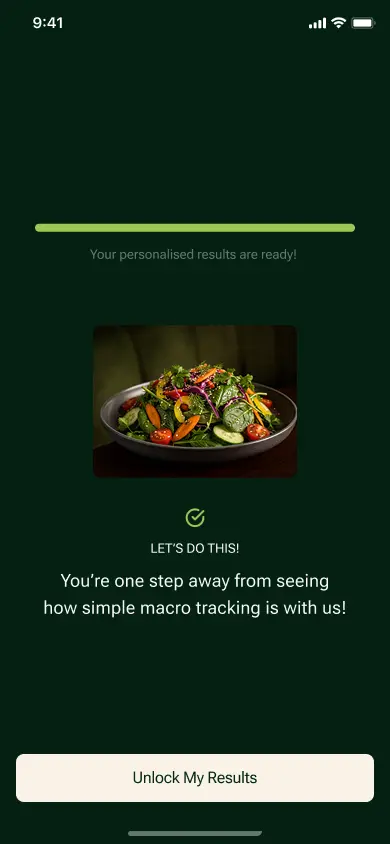
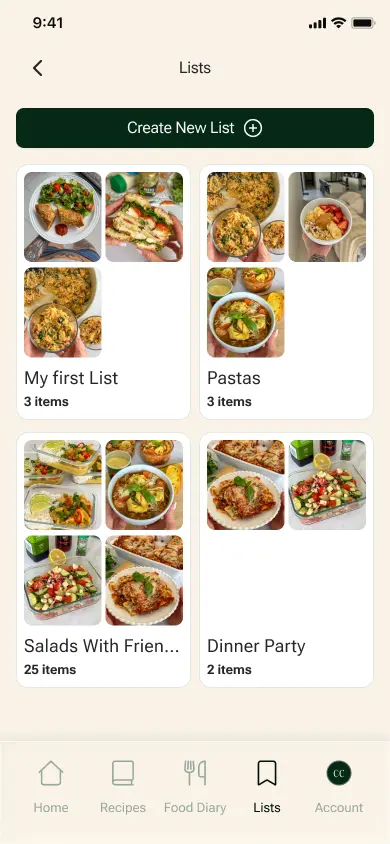
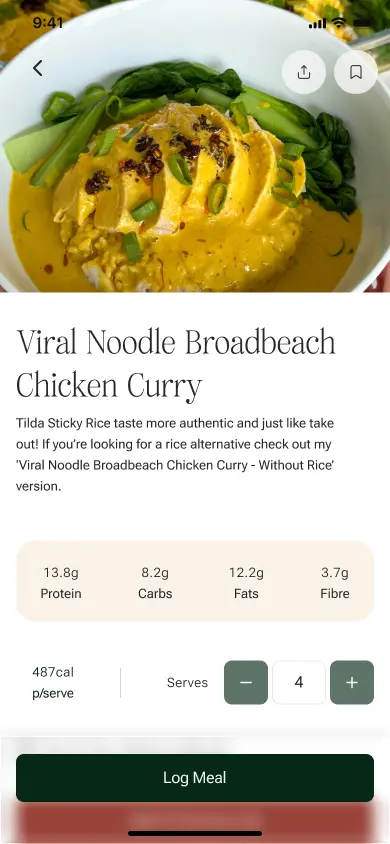
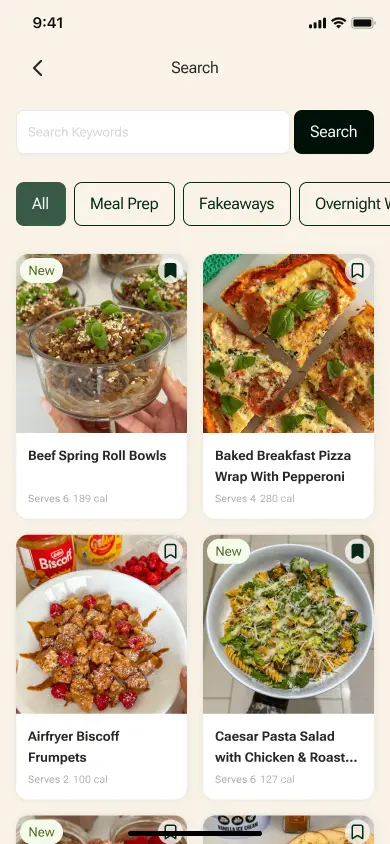
The Recipe Hub · Digital Content Marketplace
The client had a strong audience following with a paid subscription but lacked personalisation reach and dynamic content. Calories were not calculated for the individual, and macros were not able to be tracked. Her users were manually cross-referencing apps known industry-wide, with pain points of inaccuracy across platforms.
Transform her static recipe library into a dynamic nutrition platform where macro-accurate and personalised calorie targets are calculated for each individual user.
The challenge was doing this at a level of nutritional rigour that protected both her users' results and her professional credibility as a nutritionist.
Existing nutrition platforms are generic and inaccurate — eroding user trust before results can prove value. Without a way to connect macro tracking to personalised targets, the client had no digital platform capable of converting, retaining, or growing her audience inline with her business value.
The personalisation engine is built on four sequential calculation layers with various pathways, each informed by the user's onboarding answers and configurable by the coach at a platform level. The critical design achievement was building this logic to be flexible across future nutrition coaches — each coach may structure their methodology differently within this framework.
Calculated using the enhanced Mifflin-St Jeor equation with metabolic adaptation factors. Determines the user's base calorie need at complete rest — before any activity is accounted for.
Collected during onboarding: biological sex, current weight (kg), height (cm), and age (years).
BMR multiplied by an activity factor selected during onboarding. Ensures the calorie floor accounts for actual daily output — not just resting metabolism. Protects users from dangerously low calorie targets.
Users are asked to align with a goal — loss, maintain, or gain. Each associated with a pace adjustment.
Split profiles are editable by the coach at platform setup level. Different coaches may have different nutritional philosophies — the system accommodates this without hardcoding any single methodology.
Recipes are built from individual ingredients, each drawn from a verified food database with accurate nutritional data. Every ingredient has a base serving size and unit.
When a user edits a serving, either the quantity or the unit of measurement, the macros recalculate dynamically in real time. This atomic structure is what makes recipe editing meaningful. A user tracking to the gram can adjust a recipe to hit their daily target without leaving the app or second-guessing the data accuracy.
The CMS allows the nutritionist to create and manage recipes dynamically — all nutritional calculations occur automatically from the food database, removing manual data entry and human error from content creation.
Users tracking macros need micro-level control, and edit capabilities.
Allowing users to add their own recipes undermined the app value proposition. The recipes are the trust piece. Accuracy and results come from following this content specifically.
The value of a coach-curated meal plan holds higher value. Pricing this separately protects the perception of both tiers. Budget constraints did not allow for this level of service at launch.
Rather than hardcoding one methodology, the system was built to accommodate different coach philosophies — unlocking the platform's value as a capability for future nutrition clients (an internal product benefit).
This project sits at the intersection of scientific balance and human simplicity. The nutritional logic had to be accurate to produce real results for each use case of the app users. The interface had to be clean and easy to understand to ensure users would convert from competing apps.
This platform is flexible and can be personalised to the individual, scaled to multiple coaches, or expanded to other nutrition businesses trying to grow its revenue model — because the solution is based on scaling a business from the atomic level.